← Journal
Alternate Futures
The Forgotten Feminist History of Agile
What would tech culture look like if it had grown from feminist thought instead of tech bro mythology? An alternate history of agile, and the what it can offer the modern tech industry..
Written by
Shannon Mitchell
Over the past two decades, agile has been a sweeping movement leading everyone from tech giants to startups to start working differently.
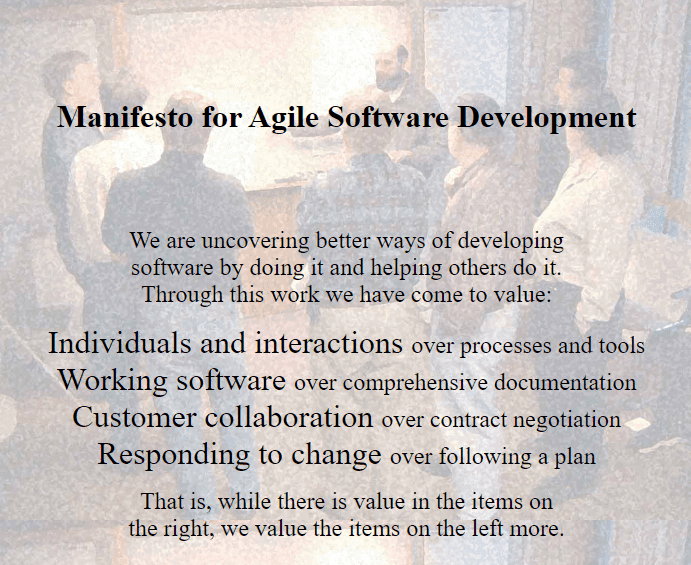
Whether or not you’ve heard of the “Agile Manifesto,” you’ve probably heard of the purported transformative nature of agile as a practice. There are entire industries now around selling tools, workshops, and seminars around “creating a responsive organization” and “adapting to change.” Strictly speaking, the agile manifesto is the founding document that gets credit for the birth of many of these new industries. It was written in 2001 when a dozen software developers came together because as they put it “We are uncovering better ways of developing software by doing it and helping others do it.”
If you haven’t tried agile, then you can pick up on the idea by reading the brief document they came up with during their meeting. Their four values and twelve principles detail a vision of success that’s about making quick working versions, and iteratively improving and updating them to reach a goal. It seems straightforward at first but once you start digging into its applications through Kanban or Scrum you can get bogged down by the complexity. As the scrum guide advertises to new readers it’s “difficult to master.”
If you don’t know what I mean, well, here’s an excerpt about the ‘heart of scrum’ from the guide:
“The heart of Scrum is a Sprint, a time-box of one month or less during which a “Done”, useable, and potentially releasable product Increment is created.”
It’s almost like it’s made to sound complicated.
Brian Marrick was one of the original founders who took part in the writing of the agile manifesto. Although many look back fondly, the way Marrick described the culture of this important milestone signals to me the root of much of the recent criticism surrounding agile. What Marrick remembered was this – “The first day had quite a lot of alpha-male-type, status-posturing-type behavior which made me pessimistic that much good would come out of the meeting.”
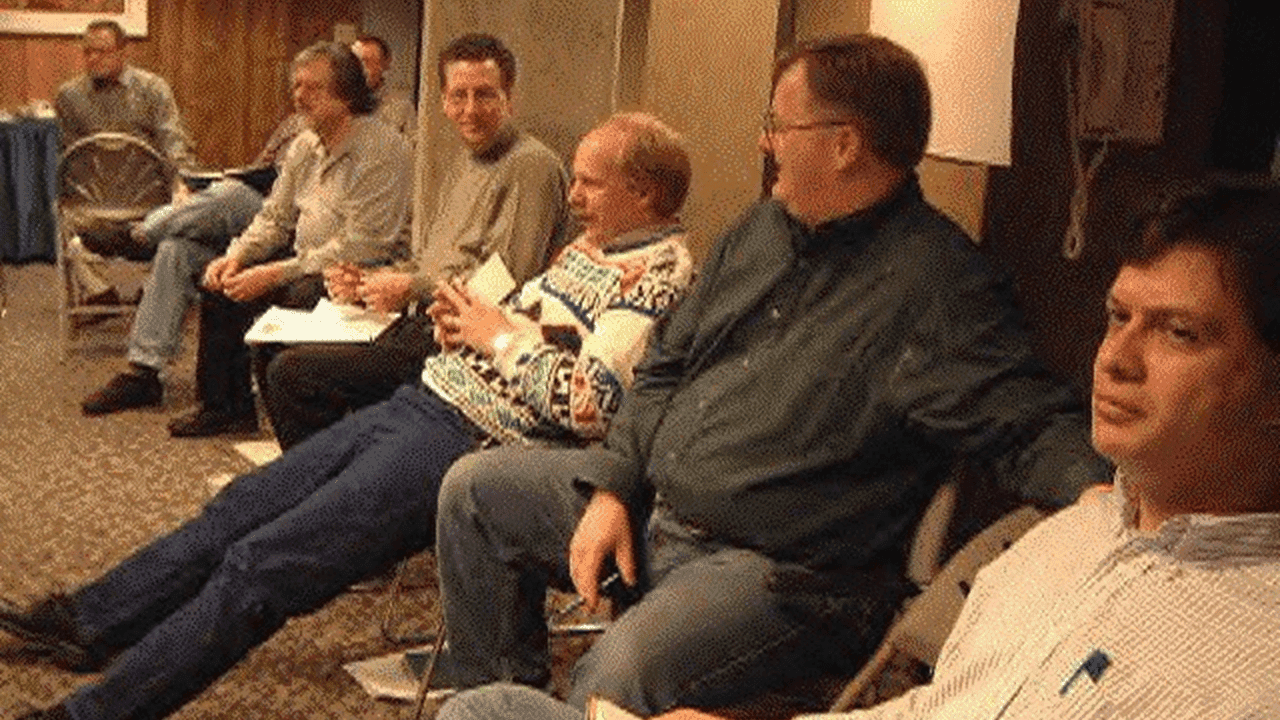
Photo from the Extreme Programming Summit where the term Agile was coined.
Sound familiar? Although agile is nowadays seen as a pathway for change culture there is an exclusive and exclusionary tone that “agile development” strikes. In practice it does not feel exclusionary, but the popular culture surrounding this theory of work has inextricably intertwined it with jargon and technical-isms which at the end of the day, as Marrick mentioned are pure “status-posturing.” Even parsing through the onboarding guides for some of these methodologies, you can feel like an outsider looking in. It makes agile seem unattainable, like it is for an exceptional, specialized group.
As such – the historic invention of agile can feel hollow. Unfortunately, most historical recounts of project management advancements fail to push any deeper than surface level trivia – such as types of car manufacturing innovations, the origin of the gantt chart, and of course the manifesto. I have always struggled to believe that something as crucial as this theory of creative labor starts and ends here.
What I do know is that the agile can and does work. Despite the popular contextualization, working together while responding to change is an ideal which continues to serve creatives and professionals alike. It’s how I work with my own team. But where did we actually build this theory of work from?
Reaction to Waterfall
To understand this let’s look back at the origins. When it was written, agile was a reaction to the status quo design process of the 80s and 90s. Before agile took hold, software was built through “waterfall” development, a process where something was coded entirely off guides, descriptions, details and manuals. Every aspect of the design was outlined at the beginning of the project – and then developers would fulfill the plan from start to finish. They didn’t allocate time toward changes, alterations, or deviations. In hindsight, we can see that this was rigid, and hierarchical. The process was made for duplicating a plan rather than devising a solution.
To make this happen developers were tasked with producing a one-to-one match to the described vision. However more often than not this vision resulted in a product which didn’t help or even worse, didn’t work. Not to say that these early builders lacked creativity or talent – the process of painstaking detail and reproduction was an artform in and of itself. What happened was that recreating an exact vision months and years after it was designed left unavoidable oversights or missed opportunities. The landscape kept evolving as the design was built, and these designs didn’t account for this.
When I say that the process of reproduction through coding was an artform – I mean it rather literally. The labor-intensive work taken to recreate through coding was reflective of one of the fundamental principles of art, mimesis, or “imitation” where you build a form true to perception through exacting detail. The steps these programmers echoed the steps classical artists take through mimesis to create a copycat version of what they see.
However skillful, mimetic work is tiresome and constricting. This was in essence what sparked the writers of the agile manifesto to consider it as exactly that – a manifesto. Their writing was intended to provoke and reject the convention of their time. As they said themselves – they felt they were “uncovering better ways” – ways that were less conventional. However, this may have been true in their industry but history shows their theorization was not the first. The same way in which the tiresome process of development through duplication was predicated in the history of design, so too was this reactionary moment predicated. Long before the agile manifesto took shape, creators had begun to reject the same academic, and hierarchical definition of fine art which fostered imitative design as the status quo. At the turn of the 20th century early modernists were making waves reacting to the strict creative conventions of art through imitation.
The Modernist Adaptation
Before the invention of agile, modern artists adapted their own methods of subverting imitative design.
Modernism as a movement departs from the classical ideals of representation in art. Before the emergence of modernism, the social convention of art was that it should “hold a mirror up to nature” and imitate that singular vision with realism. Instead, the modernist ideal was that to create, you must examine multiple contemporaneous perspectives. Consider how this concept was explained by Jacques Lipchitz ”[It’s] like standing at a certain point on a mountain and looking around. If you go higher, things will look different; if you go lower, again they will look different.” Modernist works like cubist studies iteratively layered these perspectives on top of each other, creating an exploration of the subject that changed and evolved.
 1860s Neo-classical Figure by Raffaele Monti | 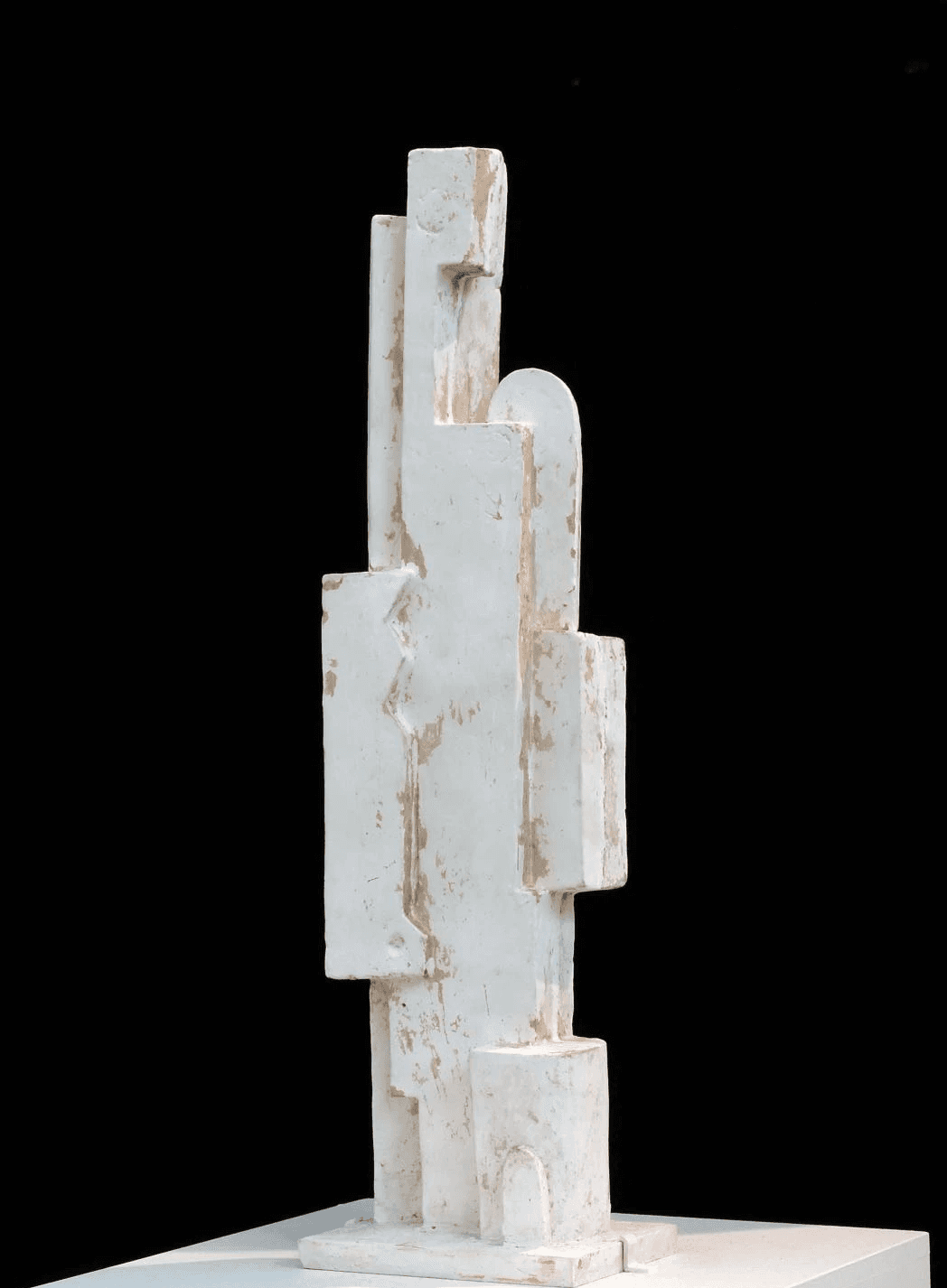 1920s Modernist Figure Sculpture by Jacques Lipchitz |
|---|
The earliest modernists worked to investigate each perspective that formed a subject, and used these disparate angles to construct it. Here is one of the foundation departures from mimetic design – that you cannot see the full perspective of a design from any singular point. Like the writers of the agile manifesto, modernists were compelled to change perspective and shift their vision over time. They believed that the first impression of a subject should be different from the final design.
Because of the reactionary similarities, artists who participated in the early movement strike a remarkable resemblance to lean-agile work in their descriptions. Georgia O’Keefe reflected “I often painted fragments of things because it seemed to make my statement as well as or better than the whole could.” It’s easy to correlate this to the later creation of user stories in scrum – where you build small, self-contained piece of functionality which each capture a statement of value.
Another modernist, Hilma af Klint wrote “The pictures were painted directly through me, without any preliminary drawings...I had no idea what the paintings were supposed to depict; nevertheless I worked swiftly and surely.” Consider the likeness this holds when compared to the later agile concept of the “potentially releasable product” mentioned earlier, where during every sprint what you worked on is rapidly ‘finished’ to the best of your knowledge over and over.
The reason for these similarities is that like agile, the modernist movement was about revisiting past ideas through deconstruction and exploration rather than planning. Both stand as reaction movements to the same constricting theory of work, and both serve as functional steps to building more creatively and adaptably.
Experimental Increments
Although early modernism centered around radical newness, as the ideals of modernism evolved into the 1960s, they further began to converge with the ideals of agile work. Fast-forward another 40 years, and the modernist perspective shifted. A new artist, Sister Corita Kent, emerged building on previous work with a wider lens.

Sister Corita Kent was best known as a pop artist famous for silk screens which took commercial slogans and images and appropriated them for deeper, more familiar meanings. What made her design perspective novel, was the way that she drew on everyday consumer works like pop songs, grocery packaging, and slogans to create artistic messages. She departed from prior modernists in her guiding belief that it’s important to repurpose and reuse work and ideas to create something even better. Where earlier modernists believed that a new design must be entirely new, she believed that innovation came out of repetition and repurposing of the old and the familiar.
Kent’s method of repetition and iteration through commercial works served as an early example of the next tenet of the agile manifesto – the importance of “Simplicity--the art of maximizing the amount of work not done.” Through her own process she focused on creating something quickly, acting on inspiration, and then stepping back to investigate. As a teacher she encouraged her students to continuously analyze their work to understand the outcomes of their “experiment” at each stage.
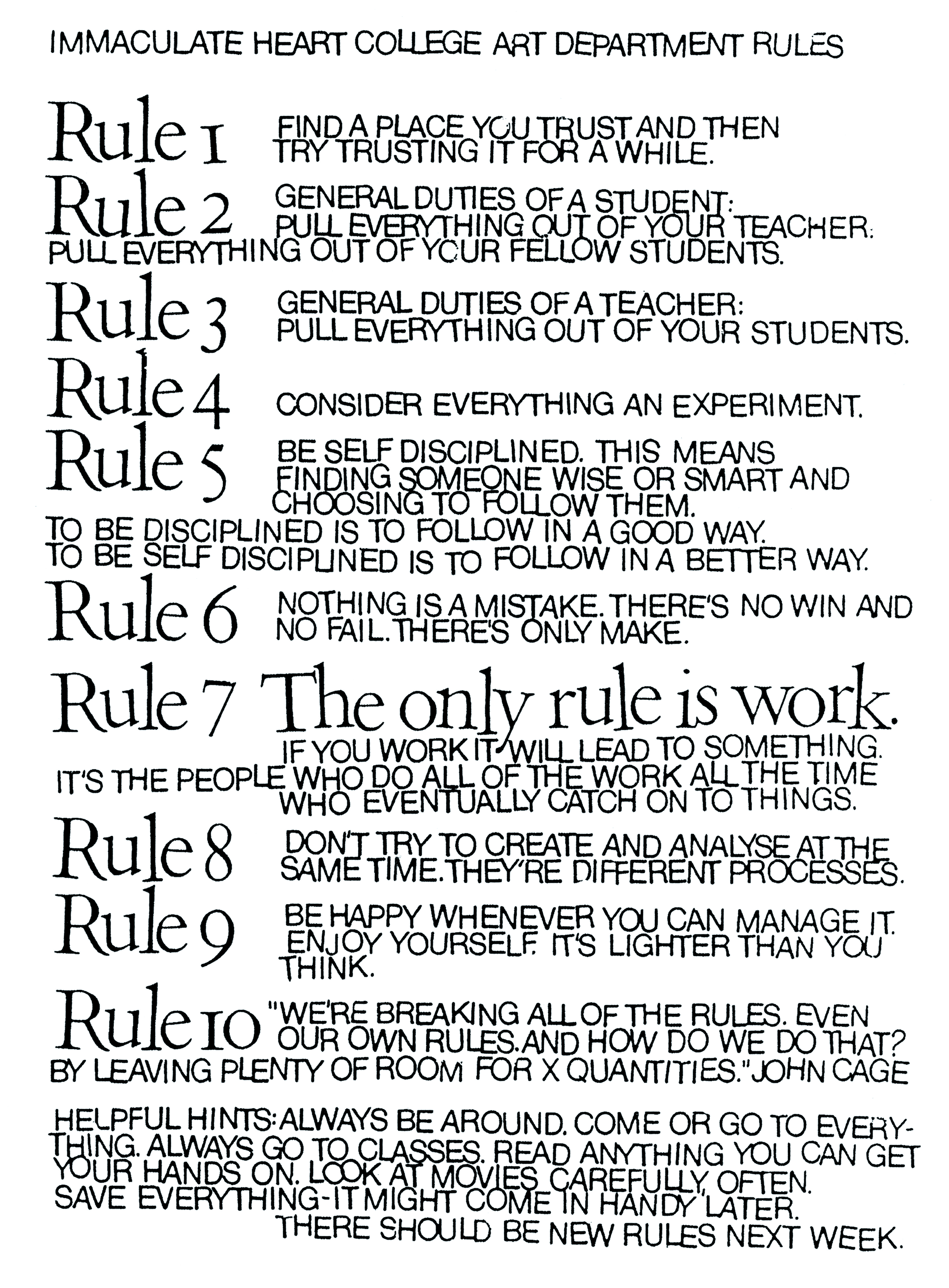
She wrote extensively on these ideas. Compare her art department rules to the Agile manifesto which came decades later:
Kent’s Art Department Rules | The Agile Manifesto |
If you work it will lead to something. It is the people who do all of the work all the time who eventually catch on to things. | [You] should be able to maintain a constant pace indefinitely. |
Consider everything an experiment. | Through this work we have come to value: Responding to change over following a plan. |
Nothing is a mistake. There’s no win and no fail. There’s only make. | At regular intervals, the team reflects on how to become more effective, then tunes and adjusts its behavior accordingly. |
Don’t try to create and analyse at the same time. They’re different processes. | The best architectures, requirements, and designs emerge from self-organizing teams. |
Be self-disciplined. This means finding someone wise or smart and choosing to follow them. | Give them the environment and support they need, and trust them to get the job done. |
Find a place you trust and try trusting it for a while. | Give them the environment and support they need, and trust them to get the job done. |
It’s easy to see the link, yet the similarities don’t end with her theory of creativity. She also pushed the vision of modernist design by emphasizing collaboration above all else. She reflects that “Creativity belongs to the artist in each of us. To create means to relate. The root meaning of the word art is ‘to fit together’ and we all do this every day.” Kent believed that to design, each creator needs to trust others, work together, and share perspectives. Agile itself is an exercise in trust – you need a strong amount of faith to work together towards a common goal, knowing that ideas could shift or that the outcome could change at any moment. Finally – Kent hit at the heart of “responsive” agile theory saying directly that “Art does not come from thinking but from responding.”
“Art does not come from thinking but from responding.”
The Postmodernist Application
As society began to move away from principled optimism of modernism, postmodernists continued to evolve this discourse around design, connection and applied creativity. Famed Afro-Futurist, and postmodernist Octavia Butler came to similar ideas through her own work saying that “Habit will sustain you whether you’re inspired or not. Habit will help you finish and polish your stories” and “You don’t start out writing good stuff. You start out writing crap and thinking it’s good stuff, and then gradually you get better at it.” Change was a central theme across her writing – in the Parable of the Sower she wrote “All that you touch you Change. All that you Change Changes you. The only lasting truth is Change.”
“All that you touch you Change. All that you Change Changes you. The only lasting truth is Change.”
Through a postmodernist lens Butler offered the perspective that iteration and redesign is not an ideal, but a necessary tool. Her influence details how these creative principles can be applied towards reaching a concrete goal – rather than serving only to explore and experiment. Unlike Kent who focused on using design to express ideas and narratives through an iterative method of work, Butler applies agile theory within a cultural context and considers the impact.
Through the parables Butler wrote, she considered the anti-authoritarian nature of change, and the importance of change as a method of widespread impact. Whereas Kent did believe “There’s no win and no fail. There’s only make.” Octavia understood that for there to be progress there needed to be goals guiding iteration and change, and that these goals determine both winning and failure. She wrote “It’s too easy to follow bad but attractive leaders, embrace pleasurable but destructive habits, ignore looming disaster because maybe it won’t happen.” Instead she argued towards setting visions of change to guide transformation rather than allowing change to follow a wandering course. She applied this to her own creativity – writing herself a vision of “I will find the way to do this. See to it! So be it!” as a guiding vision for herself to achieve renown and success as an author.
This focus on transformative vision took the theory of iteration to a new level – allowing it to be measured and applied. With this, other postmodernists began to apply the same principles of change through vision within their own work. RIOT GRRRL’s influence on writing and art within zine culture in the 90s put all of these principles into practice through creation and message. Their later manifesto describes creativity as transparency through collaboration and reflection as “see[ing]/hear[ing] each other’s work so that we can criticize-applaud each other. Postmodernism as a movement has stayed grounded in real human impact and the necessity of iteration and critique for reaching goals within their community rather than purely artistic pursuit.

Iteration Rather Than Invention
Which brings us to recent times – to 2001 and the meeting which “invented” agile work. Now, what I’ll say is that we can’t know if any of those in the room were referential or even aware of the events and movements of agile theory that preceded them. Maybe this doesn’t matter though. It’s possible that authors have reached this same conclusion independently and autonomously. Even if there was overlap – many of the earliest creators mentioned here were referential in their own work, and encouraged others to build off of their ideas and creations. They weren’t protective or proprietary about these inventions.
But knowing how much history came before the agile manifesto, and how these ideas have emerged, re-emerged, and changed over time – it is essential to recognize that the perception of new-ness around agile thinking is misplaced. Earlier, independently, and definitively – these diverse founding creators each embodied a philosophy of work driven by iteration, experimentation, analysis, and collaboration.
When we view lean-agile theory as a new development, as something recently “uncovered” we’re forgetting the nuance and the perspective gained by each of these different creators. Focusing on responsiveness, change, and collaboration was not invented alongside the internet or authored alone by a group of male engineers in 2001.
What It's Really About
For the next iteration of agile theory, we should take a meta view of this history and look to move past the current limitations of contemporary agile work. In its current practice, agile-lean methodology is not only leaving out these historic figures, but also the present-day figures who apply this theory without giving it the “agile” seal of approval. Today there are myriads of companies, organizations, creators, and non-profits who hold these same values without considering their work agile or lean. To continue moving forward, agile theory needs to acknowledge and recognize these shared perspectives, while focusing on a collective, rather than industry-based vision of creative work.
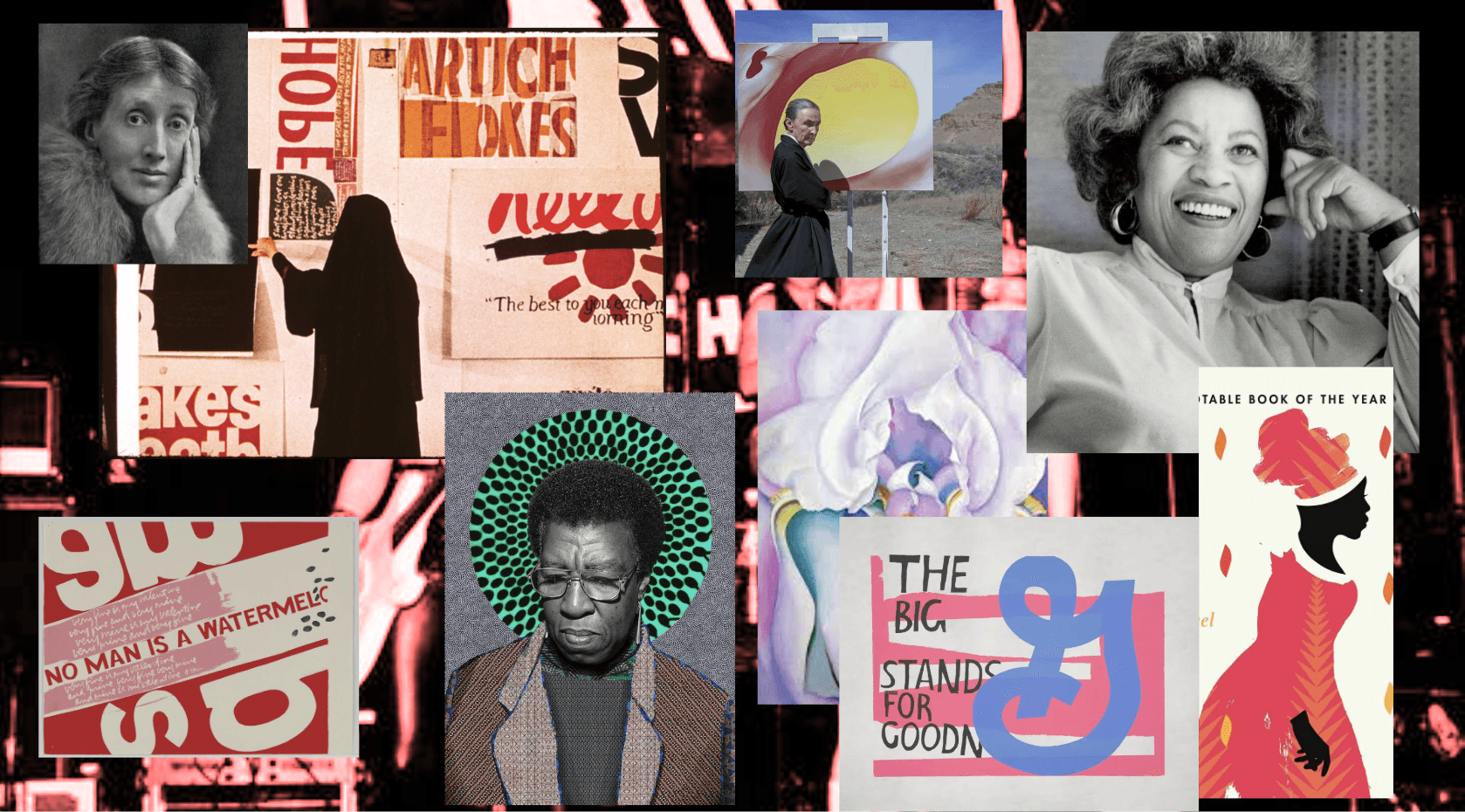
When I read through these works, I think about what creators like Sister Corita Kent, and Octavia Butler would want us to know about agile design and creativity. What stands out to me is that their words are not full of jargon, or married to technology. They share the same messages that we as a society have come to know as agile-lean design, but they explain it in a way that’s self-evident, and intuitive.
They simply explain a method of collective work that is focused on making transformative change. They teach us that letting go of an idea which isn’t working is progress, not failure and that improvement comes from routine and habit rather than a singular grand vision.
All of their ideas at the core are more inclusive and broader than what we’ve come to understand as agile-lean methodology. Their ideas are rich, diverse, and to me – more persuasive. This history demonstrates what about this theory of work is effective, and why. Most importantly – it gives us a stronger and more versatile approach to enacting change and finding new ways to work together.
If you’re interested in finding out more about this you can read more here…